What 25W tells you—and what it leaves out
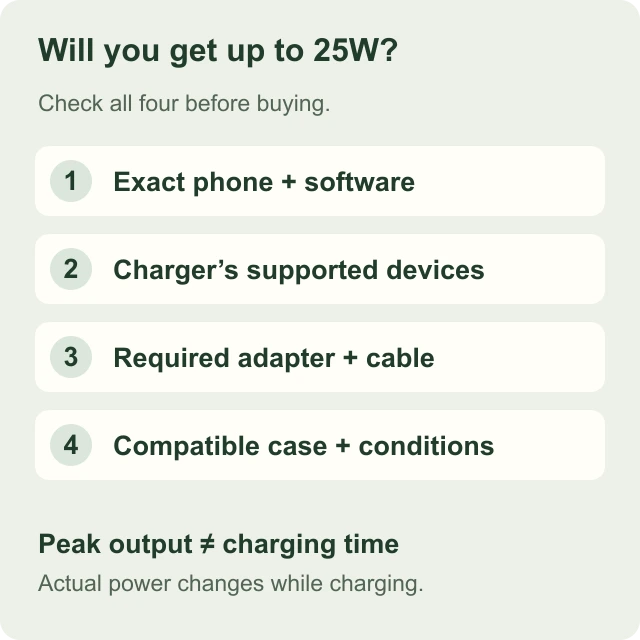
The Wireless Power Consortium introduced Qi2 25W as a higher-power development of Qi2 in July 2025. The label identifies a supported power tier. It does not tell you how long a specific phone will take to reach a particular charge level on a particular stand.
Fifteen and twenty-five watts are power figures, not battery percentages. Dividing one by the other cannot produce a reliable charging-time prediction. A phone’s charging behavior changes across a session, and the starting battery level, temperature, software, case, adapter and use of the phone affect the comparison.
We have not tested charge curves for these products. Our recommendation to consider 25W for frequent short stops is a judgment about potential usefulness when the complete setup supports it, not a measured claim that a named station saves a stated number of minutes.
Choose the scenario that matches your day
If the phone usually sits on a charger overnight and is ready when you wake up, faster peak capability may make little difference to that routine. You may get more value from a better viewing angle, a less awkward cable route or removal of an unwanted indicator light.
If you often return to a desk for twenty or thirty minutes before leaving again, higher supported wireless power is more relevant. Even then, compare the new setup with the wired charger you already own. A cable may solve the immediate problem without another purchase.
If your phone is limited to 15W on the chosen charger, consider paying extra only for other useful features or a clearly planned phone upgrade. “Future-proof” is too vague on its own: it is better to identify the next device and the feature you expect to use.
| Your situation | Start by considering | Reason |
|---|---|---|
| Existing charger works reliably overnight | Keep it | A higher maximum may not improve the result you care about. |
| Supported phone; frequent short top-ups | A documented 25W setup | The extra capability is relevant, subject to actual conditions. |
| Phone limited to 15W | A suitable 15W or well-priced 25W product | Choose the overall kit; do not pay for an unavailable speed. |
| Main problem is cable clutter | The right device combination | A better arrangement may matter more than the phone power tier. |
| Buying a gift without exact device information | Confirm the devices first | Power claims cannot compensate for a compatibility mismatch. |
Cooling is a design choice, not an automatic win
Some newer stations include fans or active cooling; others use passive designs. We include both approaches because their appeal depends on where the charger will live. A desk user may value accessible cooling controls. Someone placing the charger beside a bed may place more weight on avoiding a fan.
Manufacturer cooling claims do not establish that a station is the quietest, safest or fastest in our collection. We have not measured temperatures, acoustic levels or performance under matched conditions. Those are separate questions that deserve separate evidence.
If a station offers different cooling modes, check what changes when a mode is switched off. The headline performance may describe a configuration you do not want to use at night. Also establish whether the device remembers the chosen setting after it is unplugged; if the documentation does not say, treat that behavior as unverified.
Compare value across the whole kit
Use the same purchase boundary for both options: station, suitable power adapter, cable, and any accessory needed to make the devices fit. A less expensive station without a power supply can cost more to use than a higher-priced complete kit. If you already own a suitable adapter, state that assumption in your comparison.
Next, put a price on the inconvenience the purchase removes. A folding travel kit may replace several things you currently pack. A larger desktop station may save no packing effort at all but make a daily routine simpler. These are different kinds of value and should not be forced into a single speed ranking.
Check the return terms for the exact regional product. You can compare published specifications before buying, but your case fit, workspace and tolerance for indicator lights remain personal. A clear return route is particularly valuable when the buying decision depends on those details.
Read charging-time claims carefully
Look for the phone model, starting and ending charge levels, adapter, software, ambient conditions and whether other devices were charging. A result measured on an empty phone does not tell you exactly what will happen when yours is already mostly charged.
Do not compare two manufacturer stopwatch figures as though they came from one controlled experiment. We use such figures only as attributed manufacturer statements where the conditions are sufficiently clear. Our comparison tables concentrate on verifiable features and kit requirements instead.
For your own purchase, define the outcome first: ready for the commute, an uncluttered nightstand, or a smaller travel pouch. Choose the lowest-complexity setup that plausibly delivers that outcome. The wattage then becomes one useful specification among several.
Sources & research notes
Manufacturer information establishes documented features. Our conclusions are research-based; we have not physically tested these products.
- Wireless Power Consortium: introduction of Qi2 25W (opens a new tab)
- Apple: using a MagSafe Charger and model-specific power limits (opens a new tab)
- Anker Prime A25N1: US product information (opens a new tab)
- mophie Roam 3-in-1: US product information (opens a new tab)
Checked September 7, 2026. Spotted a changed specification or an error? Send a correction.